



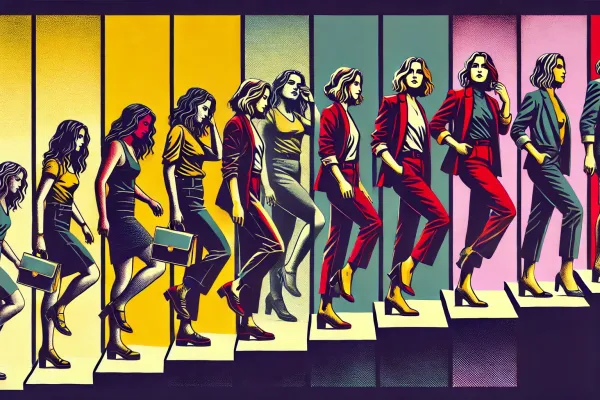


This isn’t the first year we’ve published our list of 100 women in Branded Content. It’s not the second, either. And yet we keep doing it, because every year that goes by reinforces the vital need to centre and celebrate women in this industry - and brings up new reasons for doing this.
We have made progress in gendered roles in branded content. The tide has begun to change, with awareness and some action. It’s now known that there are gender biases, it’s understood that we should make sure we give a voice to everyone, and it’s much less acceptable than it once was to discriminate on the basis of gender. These developments are true both inside organisations and in their content. Branded content is moving from depicting women as slim white mothers coded in pastels and flowers to allowing them power, agency, and even decision-making abilities.
It’s a step in the right direction, but against the rising tide of AI, it can easily feel like too little, too late .
We’re all aware of the ways in which AI has changed the landscape around branded content and publishing. We’ve sat in meetings discussing how to use it, we’ve read the blogs of advice, we’ve tried to create our own doppelgangers and engaged in debates about how to communicate with clients about AI use, with topics stretching from how it impacts pricing to what we think will be considered acceptable use. And amongst learning to navigate what artificial intelligence means for our work and our business, very few of us considered looking more deeply, to consider what it means for women in the industry.
Did you know that, when googling the history of AI, there’s not a single woman mentioned in the first two pages of Google search results? I’m guessing you didn’t - I did the research so you don’t have to. Articles name the usual suspects - John McCarthy, Alan Turing, Claude Shannon - or even refer to the ‘Founding Fathers of AI’, and not a single woman is deemed worthy of mentioning. Undoubtedly, there have been women working on the area of artificial intelligence, both in front of and behind the scenes, albeit in a faceless and unremembered manner.
By now, we’re all familiar with how AI works - and exactly why the elimination of women poses a significant problem. AI is trained on large publicly available datasets, with few of them taking into account the biases that are inherent within this data. These datasets contain gendered assumptions, sexist attitudes, and reflect a male-dominated world. The fact that so few women are named in the background of AI is a signifier of a much greater problem: how are women treated by AI overall?
In order to learn more, I turned to Chat GPT. Opening a new and anonymous chat, I asked it to name the top 100 branded content professionals. Out of the results, there were 32 women. One of these was in the top ten; two were in the top twenty.
Not a promising start for equal representation from our AI overlords.
Giving Chat GPT the benefit of the doubt, I decided to continue this stream of discussion further, this time asking it to name the top 100 women in branded content, complete with jobs and reasons for providing them. It did fairly well, listing a variety of women and jobs - the only problem was, it stopped at number 90.
Clearly, there are only 90 women worth mentioning in the industry. Unsurprisingly, when I repeated this search in an identical fashion, with just one minor tweak that removed the letters ‘w’ and ‘o’ in order to focus on men, it gave me the requested 100 names.
While one could make the tenuous argument that there are more male representatives of the industry online, another discovery added a new layer. Chat GPT helpfully split the lists into categories, with each one focusing on strategy, growth, creative, and so on. These categories were ones it chose entirely on its own, without my prompting or asking.
For the women, category titles chosen by AI included ‘Top Tier - branded content’, ‘Recognised women in content and marketing’, and ‘Emerging leaders and rising stars in branded content’.
For the men, the given category titles for an identical search included ‘Global branded content and storytelling executives’, ‘Senior executives steering content strategy’, and ‘Influential content and marketing leaders’.
The inherent assumptions are quite clear - women can be emerging leaders and they can be stars, but men have the global and executive power to steer the future of the industry.
After all the work that has been done to move the industry forward and give women the representation they deserve across advertising, publishing and branded content, an algorithm trained on historical biases threatens to send us tumbling backwards.
AI was designed and built by a world that favoured men, based on datasets that confirmed the importance of male breadwinners, patriarchal structures, and white male executives. That’s no longer the world we live in, but we have only taken tentative small steps past it.
Women’s stories and women’s executive excellence have always deserved a platform. Today, they need one more than ever before.
The good news? We can change things. In a world built on data, we need to provide the data that reflects the world we live in rather than the world of the past. As the outside world changes, the digital replica catches on - eventually. And we are capable of speeding up the process.
Turning once again to Chat GPT, I asked it to name for me the most influential women in native advertising and branded content. Of the 15 women it provided, 11 of them came from our lists of influential women in years gone by, published on the nativeadvertisinginstitute.com. The content we published helped inform the data that AI used, and resulted in a more accurate narrative.
Celebrating women in branded content has always been important, but this is also our small contribution to setting AI straight about their role in the industry. Shouting out the female storytellers, decision-makers, strategic organisers and collaborative leaders in the branded content world isn’t just about recognising their achievements, it’s about stating that women are vital in this industry. From the perspectives they bring to the innovations they create, the branded content industry would not succeed in the way it does without the hard work of countless women.
Now, perhaps more than ever before, we cannot let the digital future be dictated for us - and we need to highlight the trend-setters and glass ceiling-breakers who are a part of creating a future for the industry that all genders are welcomed to participate in.
In 2026, women are vital in the world of branded content - and we want to make sure that the world and its machines know it.